Glennkill meadow
Three Bags FullGlennkill meadow is the flock’s Irish pasture, but it is never merely a pastoral backdrop. The place where George Glenn’s body is found becomes the starting point of the sheep’s investigation; its grass and boundaries become matters of ownership and survival; and its familiar landscape carries both the flock’s memories and Rebecca’s grief. The meadow’s apparent abundance does not free it from conflict: people seek to profit from the land, Gabriel cuts its grass, and the sheep must learn how to defend a home that has lost its shepherd.
Setting and Uses of the Land
The meadow lies in the green Irish countryside, beside the hay barn and close to a path through the fields. The cliffs are near enough to shape the flock’s sense of the surrounding world: the sheep race toward the edge and turn back, while the sea forms a visible presence beyond the pasture. The setting’s openness suggests freedom, but the flock’s movements remain bound to practical limits, fences, human rules, and the dangers around them.
A small vegetable garden behind the hay barn shows how the pasture is organized as both a home and a cultivated holding. George Glenn had planted lettuces, peas, radishes, cress, tomatoes, endives, buttercups, and chives there, and fenced the beds off from the sheep. After his death, Lane pushes back the bolt and the flock eats the garden’s contents. Their raid is brief: once the beds are stripped, the sheep fall silent, feel ashamed, and return to the meadow. The episode makes the land’s plenty tangible while showing that access to it had depended on George Glenn’s supervision.
The meadow is also adjacent to the caravan and the dolmen, places that gather different kinds of significance around the pasture. George Glenn’s caravan is associated with both his ordinary life and human suspicions about what he kept there. The dolmen, by contrast, becomes part of a more inward landscape of memory and return. These nearby places do not displace the meadow; they make it a center from which the flock encounters material secrets, human history, and its own ideas about home.
George Glenn’s Death and the Search for an Explanation
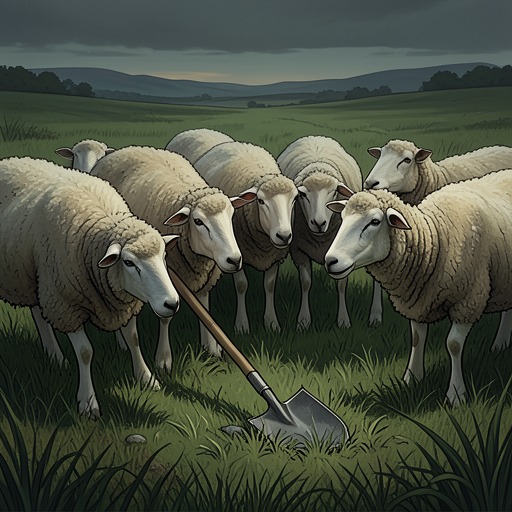
George Glenn is found lying in the grass beside the hay barn, near the field path. A spade protrudes from his body, and dew has gathered on his exposed insides. The sheep initially keep calm, but Miss Maple’s reasoning turns the meadow into the first scene of their inquiry: the wolves they fear would not attack with a spade, and the tool itself is not an illness. The ordinary grass that sustains the flock is thus also the setting in which they must confront a death they cannot explain.
As the investigation develops, Miss Maple observes that George Glenn did not scream and that little blood was left on the meadow. She concludes that he was already dead when the spade was put into him. The ground offers evidence, but not a complete answer: this deduction explains the absence of a scream without revealing why someone would stab a dead man. The pasture’s openness does not make the truth immediately visible; the flock has to learn to interpret what happened there.
Human claims on the land complicate that inquiry. Local men discuss the possibility of drugs hidden in the caravan and accuse George Glenn of making money through nighttime boats and deliveries. They also resent his refusal to admit tourists or sell the view as a commercial attraction. Their talk presents the meadow as valuable real estate and a potential business, in sharp contrast with the flock’s understanding of it as grazing ground and home. The same landscape that means sustenance and belonging to the sheep is an unrealized development opportunity to the men.
Grazing, Ownership, and Defense
The conflict over grazing becomes explicit when Gabriel’s flock is allowed onto George’s Place. The sheep of George Glenn’s flock have voluntarily left that ground ungrazed as a memorial, so the prospect of other sheep eating there feels like a violation as well as a loss of pasture. Led by Mopple the Whale, they decide to defend it. Their uncertainty is practical: they do not know how a meadow can be defended from sheep whose purpose is simply to graze.
The confrontation does not become a straightforward contest of force. The flocks push and resist, but the sheep that are nipped sound so hurt that George Glenn’s flock cannot bring itself to continue using violence. Then Gabriel’s flock stops and listens to the darkness. What follows is remembered as a sequence of flight, panting, crowding, and scattering, but not as panic or entrapment; the sheep sense that someone is herding them with skill. Soon George Glenn’s flock is back in the hay barn and Gabriel’s flock behind its wire fence. Lane watches from the cliffs. The episode transforms defense from a simple matter of holding ground into an act of collective movement that returns each flock to its place.
The pasture is also vulnerable to a different kind of human intervention. Gabriel takes George Glenn’s scythe from the toolshed and cuts grass at the foot of the hill. To the sheep, the scythe passes like a huge iron claw, flattening blades that offer no resistance. Gabriel appears to be grazing while destroying the grass rather than eating it. The scene sharply reverses the familiar pastoral image of a human tending a field: the grass is abundant, but the tool makes that abundance seem exposed and expendable. The sheep watch in silence, and Mopple the Whale trembles between indignation and horror.
Rebecca, Memory, and the Meaning of Home
Toward evening Rebecca comes up from the village on foot with a small suitcase. George Glenn’s daughter has become the flock’s new shepherdess, and she says she will live at the meadow until they go to Europe because she will not remain in the village. She tries the caravan door, works at the windows, and probes the keyhole with a hairpin, but cannot get inside. When she sits on the step with her head in her hands, the sheep recognize the pose: George Glenn used to sit there, motionless and solitary. The familiar threshold connects father and daughter without making their grief the same.
Rebecca later tells the sheep a story about a little girl with two fathers, one secret and one not. The secret father and daughter love each other, quarrel, and remain estranged; when he writes that he plans to travel to Europe and wants to see her first, she hides her joy and keeps him waiting. He waits until he dies. Though Rebecca presents it as a story, its circumstances disclose the history of her relationship with George Glenn and the regret surrounding their separation. The meadow becomes a place where an intimate family past can be approached indirectly, through a narrative spoken aloud to the flock.
That history is tied to the ground itself. Beth recalls going to the meadow in pouring rain after George Glenn told her he would have ended his life there within an hour. She found him already dead and had helped him in the manner he wanted, believing otherwise he might not be buried. The confession makes the pasture not only the site where the sheep discover a body, but also the setting of a private death and the burden carried by the person who found him.
The meadow’s pastoral beauty consequently remains inseparable from death, property, and memory. Near the dolmen, the text imagines the Way Back as something the wanderer has carried with him all along, rather than a place discoverable elsewhere in the world. That image resonates with the flock’s attachment to familiar ground, but does not reduce home to scenery: the sheep must choose, defend, and inhabit it together. In Glennkill meadow, grass is food, contested property, evidence, and memorial ground; its meaning changes with whoever stands upon it.